For an artist, earning income from your first painting sale, commission, workshop, or online shop can feel like an exciting milestone.
However, this leads to a less exciting question:
Should I pay taxes on this income before tax season?
For self-employed artists in the United States, the answer is often yes.
Unlike traditional employees, you don’t have taxes automatically withheld. You must save and pay federal income tax, Social Security, and Medicare taxes through quarterly estimated payments.
This process is straightforward to understand.
What Are Quarterly Estimated Taxes?
Quarterly estimated taxes are payments you make to cover the taxes you expect to owe for the year.
Think of them as paying your tax bill in installments throughout the year, rather than waiting until you file your annual return.
For example, an artist might earn money from:
- Original artwork sales
- Commissions
- Prints or merchandise
- Art fairs and markets
- Workshops or classes
- Licensing or royalties
- Freelance creative work
- Online shops
- Other art-related business activities
Because taxes are not typically withheld from this income, you will likely need to pay them in advance yourself.
First, Understand the Difference Between Revenue and Profit
This is one of the most important concepts for independent artists.
Suppose you get $30,000 from your art business during the year.
This does not mean you will be taxed on the full $30,000 as business profit.
You may also have legitimate business expenses such as:
- Canvas, clay, wood, metal, fabric, or other materials
- Paint, brushes, tools, and studio supplies
- Framing
- Packaging and shipping
- Art fair or exhibition fees
- Website expenses
- Payment-processing fees
- Business insurance
- Advertising
- Certain studio expenses
- Other ordinary and necessary business expenses
For example, if your art business earned $30,000 and you had $10,000 in deductible business expenses:
Your simplified calculation would look like this:
$30,000 revenue
− $10,000 business expenses
= $20,000 net business profit
The $20,000 net profit is the key figure for estimating your taxes.
This highlights the importance of good bookkeeping.
Why Self-Employed Artists May Owe More Than Expected
Self-employed artists may have to think about two major federal tax components:
1. Federal income tax
The amount depends on your total taxable income and individual tax situation.
2. Self-employment tax
Generally, the self-employment tax applies to the Social Security and Medicare taxes for individuals who work for themselves.
Employees typically share payroll taxes with their employers. When you are self-employed, you pay the full amount, which often surprises new freelancers and artists.
Your actual tax liability involves more than simply applying a single tax rate to your art income.
How much should an artist save?
No single percentage suits all artists.
Your tax situation may depend on household income, filing status, deductions, credits, state taxes, other income sources, and other factors. If you are new to self-employment, setting up a dedicated tax savings account can be very helpful.
Each time you earn income from a sale, commission, workshop, or project, transfer a portion into your tax account.
For example:
You are paid $1,000 as a commission.
Instead of treating the full $1,000 as available to spend, immediately transfer a portion to your tax savings account.
You might divide each payment into three categories: expenses | Taxes | Money available to you
The amount you set aside for taxes should reflect your specific tax situation, rather than a fixed percentage.
When are estimated taxes paid?
You usually pay federal taxes four times a year.
The IRS sets specific deadlines for each period, which are not always exactly three months apart.
It is best to review the current IRS estimated-tax table each year, rather than assume payments are due every three months.
You can also use Form 1040-ES, Estimated Tax for Individuals, to help calculate your estimated payments.
A Simple Quarterly Routine for Artists
You do not need complex accounting software to establish an effective quarterly tax routine.
At the end of each quarter:
Start by totaling your income from art.
Make sure to include income from sales, commissions, workshops, online sources, and all other business revenues.
Step 2: Keep your business expenses up to date.
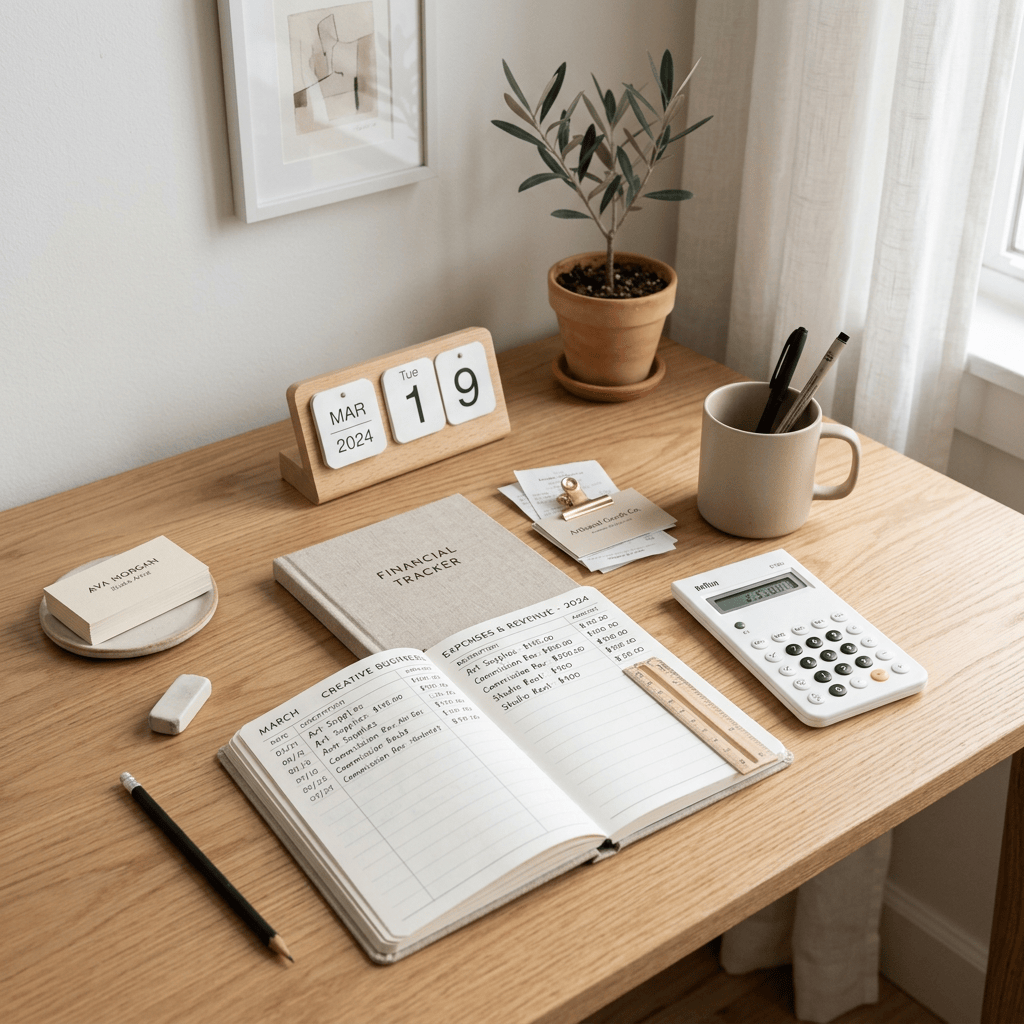
Record all receipts and expenses in your bookkeeping system.
Step 3: Work out your estimated net profit.
Subtract your business expenses from your revenue to determine your net profit.
Step 4: Check how much you have already put aside for taxes.
Compare your tax savings with your estimated tax liability.
Step 5: Calculate the amount you will receive after taxes.
You can use IRS Form 1040-ES, tax software, or a tax professional.
Submit your payment by the required deadline.
Keep the payment confirmation with your tax records.
Start the next quarter with updated records.
What happens if the amount of money you earn from your art varies during the year?
Artists rarely receive exactly the same amount each month.
You might earn:
January: $600
February: $900
March: $4,500
You may then earn very little for several weeks.
A later exhibition or major commission could also bring in another $8,000.
Irregular income is common in the creative sector.
Quarterly payments do not need to be identical. If your income changes significantly, adjust your estimated tax calculations accordingly.
That is another reason quarterly bookkeeping is so valuable.
Instead of waiting until April, review your situation throughout the year so you can adjust in a timely way.
What if you have a conventional job too?
Some artists have income from W-2 employment as well as self-employment.
In that case, tax may have already been deducted from your regular paycheck.
In some cases, you can adjust your paycheck withholdings rather than relying solely on separate estimated payments.
It is important to consider your entire tax situation, not just the income from your art business.
Don’t Wait Until Tax Season to Organize Your Records
One of the easiest mistakes to make is thinking:
When I file my taxes, I’ll make sure to sort out all the details.
At that point, you may find yourself reviewing a year’s worth of bank statements to determine whether each purchase was personal or business-related.
A better approach is straightforward:
Record income → Record expenses → Review profit → Reserve taxes → Review quarterly
You do not need perfect bookkeeping.
You need bookkeeping you can keep up with consistently.
A Small Habit That Can Help: You need a bookkeeping system you can maintain consistently.
That when you see the money in your checking account, it may as well be $2,000 that you have available to spend.
However, you may ultimately owe a portion of that amount to the IRS.
Separating tax funds as income arrives helps establish a clear boundary: Money spent for business purposes is not necessarily personal spending.
This habit can significantly reduce tax-season stress.
Final Thought
Quarterly estimated taxes may seem intimidating at first, but the underlying process is straightforward:
Know what you earned.
Know what you spent.
Know your approximate profit.
Set money aside.
Check your taxes during the year.
Your bookkeeping should not distract you from your creative work.
When managed well, it supports your creative process.
It provides a clearer view of your business, allowing you to spend less time worrying about finances and more time creating art.
Disclaimer: This article is for general educational and informational purposes only and is not tax, legal, or financial advice. Tax rules and individual circumstances vary and may change. Consult the IRS and/or a qualified tax professional regarding your specific situation and current estimated-tax requirements.


Leave a comment